Followers

Monday, May 29, 2017

🌻🍃🍅 No. 3.5: More Dibbles #100GardenHacks 🍃🍓🍃

I am working on a project for the 2017
growing season to work my way through
100 garden hacks*.

Dibbles, continued: Old Toothbrushes

I've long noticed old toothbrushes are kept in tool boxes for various uses, and once I realized how handy they can be I started saving them as a craft supply. And now I've discovered another use for those brushes that get replenished every 3 months (assuming recommended dental hygiene is being practiced).
The end of the handle makes a great dibble, and unlike the chopsticks, 
the toothbrush can be used to brush the soil back over the seed 
or even disperse tiny seeds (e.g. chives).


🕊, 💌,  & 🍃
~KF

*101+ Garden Hacks magazine. 2017. Rodale, Inc. 

I found this copy on a CVS magazine stand :)
However, portions of this publication
previously appeared at RodaleOrganicLife.com


Friday, May 26, 2017

The Humans

I'm learning how one of the most the important parts of developing a community space requires me to stay open to land uses I don't anticipate. I'm thrilled my time spent in environmental science has exposed me to the importance of staying flexible: we can't dictate what natural spaces mean to one another.

This spring I let some dirt bikers have at the back of the property that hasn't been developed yet. They've done this amazing job building a really fun track and it looks great! What used to be nothing but a weed-filled tick haven is now a comfortable space for people! And a terriflc walking path when the bikers aren't there. And the bike racers have been nothing but polite to our gardeners, no trampling on growing spaces and they've even offered to help is fix a greenhouse roof. I'm thinking this back lot may just need to stay a dirt bike track indefinitely.
#theoryandpractice


Cottonwood seed is like nature's fingerprinting dust for cobwebs.


We are like the Little Shop Of Horrors for wild carrots back here!

I don't even understand what kind of vascular system I'm seeing here!! Until, that is I found out it's poison hemlock: purple blotches on stem and much earlier in the season compared to the late summer blooms of wild carrot (a.k.a. Queen Anne's Lace)

Thursday, May 25, 2017

🌻🍃🍅 No. 3: Soil Dibbles #100GardenHacks 🍃🍓🍃

I am working on a project for the 2017
growing season to work my way through
100 garden hacks*.

Repurposed Chopsticks

Another hack for overgrown takeout cutlery collections.
Disposable chopsticks make a nice soil dibble, for creating an easy seed planting space in soil or growing mix. Dibbles help new gardeners and kids to help ensure seeds are easily planted at the correct depths.

If you have a ruler handy, you can mark off measurements.
🕊, 💌,  & 🍃
~KF

*101+ Garden Hacks magazine. 2017. Rodale, Inc. 

I found this copy on a CVS magazine stand :)
However, portions of this publication
previously appeared at RodaleOrganicLife.com


Monday, May 8, 2017

🌻🍃🍅 No. 2: Plant Markers #100GardenHacks 🍃🍓🍃


I am working on a project for the 2017
growing season to work my way through
100 garden hacks*.
Garden Hack #2: Plant Markers (repurpose)

 Have one of these collections?

You can turn them into easy plant markers for a quick way to keep up with a large amount of seed sowing (like early spring when testing all those leftover seeds from last year). It can get as decorative as you want, like the photos below of some I used on a seed project with kids. I wanted to jazz them up a little for some fun & individuality.


I used nail polish because it has become a staple for garden use. It already designed for easy application in small areas, and it holds up well to weathering at least for a season; non-toxic varieties are increasingly easier to find, too, if that's a concern for you. 


Other, more perfunctory, easy labeling methods can just involve a sharpie, maybe even some tape. 


I liked this hack because besides helping with a large amount of spring plantings while requiring little planning or expense, it also helped spring-clean out the drawer of disposable takeout accoutrement.

🕊, 💌,  & 🍃
~KF

*101+ Garden Hacks magazine. 2017. Rodale, Inc. 

I found this copy on a CVS magazine stand :)
However, portions of this publication
previously appeared at RodaleOrganicLife.com


Friday, April 28, 2017

🌻🍃🍅 No. 1: Seed Viability Testing #100GardenHacks 🍃🍓🍃


I am working on a project for the 2017
growing season to work my way through
100 garden hacks*.
Garden Hack #1: Testing Seeds for Viability 

Each year new seeds come in, but not all get planted. Many retain a high rate of viability for more than one year and it can be great to reduce waste and essentially double your return of investment (ROI) on seed purchasing, as well as the investment of energy and time involved with seed collecting.

Though you can just plant them all, it sometimes is not possible to use up materials (especially space) or have to purchase more seed germination specific materials just to to check if old seeds are still able to produce.

This method appealed to me because it sounded easy:

  • no potting mix needed
  • no flats of mismatched pots
  • simple way of reducing moisture loss with the lid


This method also minimized mess mess as well, which makes it easily mobile and easy cleanup - all handy features for working with kids, i.e. you could take indoors and not worry about floors and furniture.


Moistened coffee filter
Plastic container
Clear lid that covers the dish - it does not need to fit perfectly
moisten the filter
put the moistened filter in the container,
multiple filters can be used
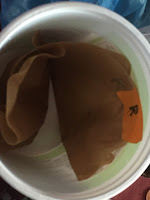


include labels if using multiple
types of seed with multiple filters
spread the seeds out on the filter
and cover with the lid

Do not place the container in direct sunlight as you wait for the germination and check on it daily:

  • ensure the paper stays moist - just moist, not standing in water or dripping, or so wet that the paper tears, etc. 
  • and look for germination. 
You may be able to see the germination without opening the filters once the seed germinates and pushes against the paper. You should be able to see lumps in the paper or changes in the way light passes through.

If you want to open the filters to look directly at the seeds changes in the seed: cracks in the seed coat, and emerging white/green tissue should appear as the root (radicle) forms. 
 

Knowing when to call a seed unviable can be like microwaving popcorn. If any seeds in the batch germinate, if any have still not responded by the time your germinated seed/s are ready to be planted than you'll know those duds can be composted. However, seeds vary in their germination times; some seeds take longer than others to trigger the seed to open and the plant embryo to develop. Older seeds can also take longer than younger, larger or thicker seeds take longer, etc. 

So if you have a batch where you see no germination in the entire bunch, you may want to give them a few weeks just to be sure. There are some extreme germination times out there, but generally speaking after 4 weeks with no response from the seed ,you can go ahead and compost the entire unviable batch.

*101+ Garden Hacks magazine. 2017. Rodale, Inc. 

I found this copy on a CVS magazine stand :)
However, portions of this publication
previously appeared at RodaleOrganicLife.com


Monday, August 15, 2016

Genetic Dirt Blindness


Checking for germination this morning and when scanning the flats, I thought about how much focus it takes to spot a just-barely-germinated seedling. Not just because they're small, but also because of the lack of color contrast - particularly if you have any perlite that has gone a little green or moss, or chunks and flecks of mineral content.

Not to mention some embryos keep the seed integument on as endosperm gets absorbed, and on top of that small soil particulates can adhere to the seed integument further decreasing visual contrast between seedling and substrate.


All seems like echoes of an amusing party conversation from the previous night, presented as an explanation for why women see housekeeping details that go largely unnoticed by males, historically sparking domestic gender clashes. The concept is  popularly known as Male Genetic Dirt Blindness and is summarized as a sex differential in human vision that suggests a female vision preference favoring fine focus duties such as seed sowing (gatherer labor) vs. larger landscape viewing as would be required for traditionally male duties like hunting.

In terms of biological trade-offs*, something like less color distinction likely reduces distraction making motion, brightness, and contrast more highly detectable.

Seems legit enough so I tried to find the book that is referenced in Barry's article (link listed above) to see what neurological studies the idea was based on (the book summary linked above claims to be based on two decades of neurological research). Unfortunately my public and OSU libraries showed no holdings of this book, although OSU does have several of the author's other titles.

Also few scholarly google searches did not produce any articles on the specific subject of vision differences attributed to hunter-gather effects on human natural selection.

Despite the lack of serious academic evidence found so far on MGDB, I can't help but notice, due to genes occurring in on the X chromosome that have no analogous Y loci,  males do share a known sex-linked color deficiency, and that limited range of color is thought to be also found in another anthropologically significant daytime hunting species: wolves. And as I scan for seed germination, the idea seems more and more intuitive.

And maybe that's at the pattern I've experienced with all the mansplaining.  Just another reminder that I see my greenhouse projects the way I see them, and that vision is always going to be different from the way anyone see things, particularly the men who think I can only come at things from industrial sized, fossil-fuel guzzling equipment.


Here's to pint-sized, yet large effect, trailblazing. :p

*Incidentally, in questioning why the trade off? Why not being able to see both fine details and motion? Maybe some individuals can, just like what we might expect if there were a normal distribution across any population. These individuals just would not represent the majority, but rather the tails of the bell curve. Some individuals probably can do both and we know this fewer group of individuals by how they excel in types of skills professionally or recreationally (e.g. marksmen).

Monday, May 30, 2016

Happy Memorial Day, from my underwear

2.5 months and I can feel that I'm in that place after a move where I belong no where, not to Chicago anymore and not yet to central Ohio. I have a really heavy intuition that things are going to get a lot weirder before they settle into something I can recognize as an extension of myself. It might be the poison ivy+cold+migraine events of the past week, but this Memorial Day feels like the light vomiting before a good trip.

I'm laying in the backyard in my bra and underwear listening to the frogs and the birds, and whatever else is buzzing, but mainly it's loud frogs and birds. Loud birds like cardinals, and what I think are a pair of mockingbirds keeping things interesting and nesting up on the porch. Jesus, I can't even think of the last time I saw or heard mockingbirds. And loud ass bull frogs. I'd forgotten just how much they sound bovine. I'm so ever aware I don't know fuck about shit right now. And I'm laying in the backyard in my bra and underwear because there's no reason not to. There won't be a single disruption to this scene except the sunset.


Thursday, May 26, 2016

Mowing/progress with Andy's employees

You guys. One of neighbor Andy's guys actually talked to me today. When I gave my usual "hi there" he stopped his truck and we had a bonafide conversation. I made him laugh with this weird resin ball that is today's contender for coolest-thing-found-n-the-ground. 2 months, but I may be finally charming the neighbors with my awesomeness. It could be a new dawn.


Followers